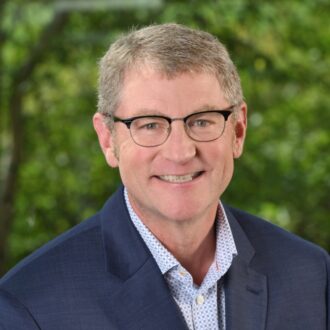
As a professor in Michigan State University’s Department of Animal Science and co-director of the Center for Regenerative Agriculture, Dr. Jason Rowntree has dedicated his career to improving the sustainability of beef production and grass-based farming systems both in the Midwest and around the world.
Rowntree’s service to SARE spans many years, including his time on the North Central Region SARE (NCR-SARE) Technical Committee from 2017 to 2021, and his leadership on the NCR-SARE Administrative Council and Executive Committee as the Technical Chair for the Research and Education Grant Program.
Over his tenure at MSU, Rowntree has emerged as a premier state and regional leader in quantifying the environmental impacts of grazing enterprises. He was an early pioneer in measuring livestock greenhouse gas footprints and determining the specific drivers of soil organic carbon sequestration. A dynamic researcher and practical educator, Rowntree centers producers in his work, helping them navigate market-based sustainability transitions within the beef supply chain while ensuring complex science translates directly to practical management solutions on the ground.
Some of Rowntree's work has been backed by USDA-SARE. Between 2012 and 2016, his NCR-SARE Research and Education project mainly targeted Michigan beef producers. It led to advances in science-based grazing techniques and boosted local rural economies. The success of these early efforts opened doors to further opportunities, including a recent $19 million USDA FFAR grant. This grant involved an interdisciplinary team across 11 academic fields at 12 universities, as well as federal agencies and industry partners. In recognition of his leadership in research, MSU awarded him the esteemed Charles Stewart Mott Distinguished Professorship of Sustainable Agriculture.
Internationally, Rowntree has conducted agricultural workshops and advised sustainability boards worldwide. He has traveled to countries such as Zimbabwe, Kenya, South Africa, Australia, New Zealand, Saudi Arabia, and the United Kingdom to share his expertise on regenerative grazing systems and sustainable livestock management. Closer to home, through his collaborations with Michigan State University's Michigan Inter-Tribal Land Grant System, he has developed strong partnerships with Bay Mills Community College and Michigan State University Extension, and supported the Tribal Food System Needs Assessment and Action Plans for the 12 Tribal Nations in Michigan. He has testified before the U.S. Senate Agriculture Committee to advocate for vital Research and Extension priorities in the Farm Bill. He has also served as Chairman of the Board of Directors and on the Board of Directors of the American Grassfed Association and the Grassfed Exchange, and lends his expertise to advisory committees for the North American Meat Institute, Regenerate America, and the Savory Institute. Throughout his career, he has acted as a trusted mentor to dozens of students and early-career scholars, investing in their professional and personal growth to shape the next generation of sustainable agriculture professionals.
Leaders in sustainable agriculture offered tributes as Rowntree was nominated and selected to receive this recognition, including:
- I’m so pleased to hear that Dr. Rowntree has received this well-deserved recognition from SARE for his research and leadership in the areas of beef cattle production and regenerative grazing systems. While this work began at our MSU Lake City Research Center in Michigan, it has received worldwide attention. Dr. Rowntree’s approach emphasizes practical and applicable solutions for producers and ranchers, while promoting the economic sustainability of their operations and long-term environmental benefits. His impact on Michigan agriculture and beyond is undeniable. We’re privileged at MSU to have access to his expertise and ability to assemble leading experts to solve some of agriculture’s biggest challenges. – Dr. George Smith, Director of Michigan State University AgBioResearch
- I can’t think of anyone more deserving of the 2026 NCR-SARE Heroes Recognition than Jason Rowntree. I first met Jason in 2015 when he brought me on as a master’s student, and one of my very first projects was leading SARE focus groups with producers who had implemented regenerative grazing practices in the region. Even then, it was clear that Jason’s approach to research was rooted in listening to producers and building science around the questions that mattered most to them. Over the past decade, I have watched Jason turn the Lake City Research Station into a hub for regenerative grazing research, education, and producer engagement. Through his vision, persistence, and ability to bring people together, he has created a space where producers, researchers, students, and industry regularly come together to learn from one another and advance sustainable agriculture. Under his leadership, the station has become a testbed for numerous SARE-funded regenerative grazing projects and a place where producer questions are turned into research, and research findings are then translated into demonstrations and practical learning opportunities. Central to my experience with Jason as a SARE hero is his remarkable ability to invest in people. More than a decade after I began my master’s with him, he remains one of the most influential mentors in my life and career - a sentiment I know is shared among all of his former students. He creates opportunities, builds connections, and supports people in the sustainable agriculture space long after they leave his direct orbit. His impact can be seen not only in the science he has helped advance, but in the many students, researchers, extension professionals, and producers he has inspired along the way. The field of regenerative grazing research — and our understanding of how grazing can contribute to more sustainable beef production — is stronger because of Jason’s vision, leadership, and commitment to producers. – Stanley Paige, Colorado State University
- I was lucky enough to be connected to Jason through our work at SARE. I had the pleasure of visiting his SARE Research and Education project at Michigan State’s Lake City Research Center. In a true systems approach, Jason was working with ranchers, meat processors, and chefs to produce grass-fed beef for the local market. For our visit, he brought participants together to share their stories about their participation in the research over a delicious steak meal, making sure they were front and center in the discussion of the work. We were so impressed with Jason’s project that we asked him to serve first as a reviewer for the SARE Research and Education program, and then as the Chair of that review committee. In that role, Jason continuously showed his commitment to farmer-driven and farmer-led research. I remember one especially intense discussion as we were debating whether to fund a project on “the bubble.” Jason had concerns that, statistically, the setup would not yield strong conclusions. But he listened to the farmers and ranchers on the review team who felt strongly that the exploratory work was badly needed, and voted to fund the project. He was a creative thinker and hard worker, and a joy to work with. He has done so much to advance grazing and systems research in the Midwest and has greatly contributed to NCR-SARE’s impact. He truly is a SARE Hero. - Dr. Beth Nelson, retired NCR-SARE Regional Coordinator and Director of Research and Education Programs
- I have known Jason since 1994, when I was an Assistant Professor at Mississippi State University, and Jason was working on his Master's. We ended up at Michigan State University at the same time by happenstance in 2009. Jason has always been producer-oriented with a goal of addressing global issues by solving them at the local level. Jason is a rare academic in that his research is groundbreaking while being rooted in practicality. I do not know of any professor working in the field of regenerative agriculture that has had a bigger impact, not only in the United States, but on a global scale. NCR-SARE has been instrumental in making much of his work possible through their support of his research on grass-fed beef as well as the impact of grazing on ecosystems. Being his colleague for the last 17 years was the most rewarding period of my academic career. Jason Rowntree is truly a hero to those who want to make agriculture more sustainable. - Dr. Matt Raven, Michigan State University