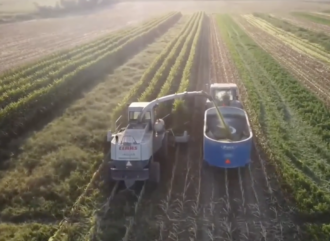
For Adam Hurtgen, a sixth-generation dairy farmer at Hurtgenlea Holsteins in Elkhorn, Wisconsin, protecting natural resources is just as vital as feeding his 160-cow herd.
To tackle the triple challenge of erodible soils, rising feed costs, and complex nutrient management, Hurtgen turned a 4.4-acre plot into a living laboratory to test a single-pass alfalfa-corn silage intercropping system.
With support from a $14,355 SARE Farmer-Rancher grant, Hurtgen collaborated with crop advisers, engineers, and university researchers to prove that farmers can grow high-quality forage while conserving resources.
Key Findings: Forage Without Compromise
Their multi-year trial evaluated five distinct treatments, comparing traditional 30-inch corn controls and standalone alfalfa against 30-inch and 60-inch corn rows interseeded with shade-tolerant, glyphosate-resistant alfalfa. The intercropped systems let the sixth-generation farmers grow more quality forage on the same land base and utilize more of their manure:
- Comparable Silage Yields: In the first year, the 30-inch corn intercropped with alfalfa produced silage yields statistically identical to those of the traditional 30-inch corn control. Only the wide-row 60-inch corn with alfalfa saw a noticeable drop in silage yield.
- Uncompromised Feed Quality: Feed analysis conducted by Rock River Laboratory revealed that nutritional quality remained exceptionally high across the systems, averaging an impressive 3,585 pounds of milk per ton of forage.
- Resilient Living Cover: The interseeded alfalfa successfully established itself beneath the corn canopy. Even after facing the heavy wheel traffic and compaction of corn harvest, the alfalfa in the 30-inch rows rebounded in the fall, matching the vigor of standalone alfalfa plots.
- Immediate Soil Protection: The continuous living cover paid immediate dividends. During intense rainfall events, Hurtgen observed that the intercropped soil "stayed put," reducing the soil displacement and nutrient runoff that bare, sloped fields can experience during a winter fallow period.
"We learned that it's possible to establish alfalfa in corn silage with yield similar to the corn silage only," said Hurtgen.
Recommendations for Farmers
For producers looking to implement a similar alfalfa-corn silage intercropping system to maximize land-use efficiency and safeguard their soils, Hurtgen shared some advice:
- Be Patient: Do not rush the tractor into the field. With increasingly wet spring conditions in the Midwest, waiting for a clear planting window with the right soil conditions is paramount to achieving a healthy, even establishment for both crops.
- Know Your Equipment Manually: Do not rely strictly on automatic implement settings. Hurtgen emphasizes that success hinges on taking the time to manually adjust planting and harvesting machinery to accommodate the tight spacing and unique row configurations.
- Evaluate Cutter Bar Heights: Carefully check your fields and machinery capabilities beforehand. Knowing your optimal cutter bar height is essential to harvesting the corn silage effectively without destroying the underlying alfalfa crowns that will provide future cuttings.
- Dial In Second-Year Suppression: Be prepared for a learning curve in the second season. Properly timing a mild chemical suppression (such as a partial rate of 2,4-D) after your spring alfalfa cut is necessary to keep the alfalfa from outcompeting the corn during its critical early weed-control window.
Hurtgen and the team shared their findings with more than 260 farmers and agricultural professionals through field days, presentations, and high-profile showcases like the World Dairy Expo. Looking forward, they are running test plots on the rate and timing of the suppressant, especially the 2,4-D application rate.
"We want to be good stewards of the land and further our social responsibility," said Hurtgen. "This project has allowed us to reach out to ag professionals and farmers who have great ideas to make this system work on our farm and other farms. We learned that there is ample interest from ag professionals and farmers in a corn silage-alfalfa system that can provide multiple cuttings of alfalfa and corn silage for better land use efficiency and soil conservation."