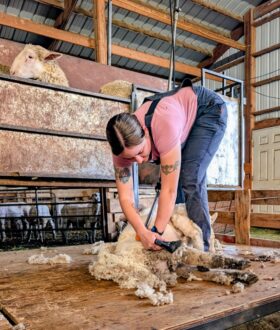
Producers of small-acreage sheep operations in the Northern Plains have been facing a shortage of skilled sheep shearers. Because travel costs make hiring professionals prohibitively expensive (ranging from $10 to $20 per animal for small flocks), finding local solutions can help sustain smaller operations.
To help bridge this gap, educators Jaelyn Whaley, Chris Schauer, and Brent Roeder teamed up with professional shearers to host six intensive, three-day regional shearing schools in South Dakota, North Dakota, and Montana.
Hands-On Skills that Cut Costs
Shearing is a skill that can be hard to learn safely from a book or video, so schools provide critical, hands-on instruction. With support from a $19,940 NCR-SARE Partnership grant, six sheep shearing schools were hosted in MT, SD, and ND (3 in 2024 and 3 in 2025). Participants focused on:
- The Shearing Pattern: Beginners learned to shear a sheep efficiently without stopping, while those with some experience improved their speed.
- Equipment Care: Hands-on practice with blade sharpening, machine oiling, and gear maintenance.
- Animal & Shearer Welfare: Techniques to minimize sheep stress and stretching exercises to prevent shearer injury and fatigue.
- Wool Quality: Basic handling to preserve clip value for traditional markets or emerging local uses, like sustainable garden mulch.
Cultivating the Next Generation
The payoff of these schools is already being felt at the local level. The team reported that for many producers, learning to shear their own sheep has lowered their annual input costs, a major win, especially for those raising coarser-wooled breeds with tighter commercial margins. For others, the school has provided a new source of income. Beginners started by servicing smaller local flocks to build up their daily tallies while also addressing a community need.
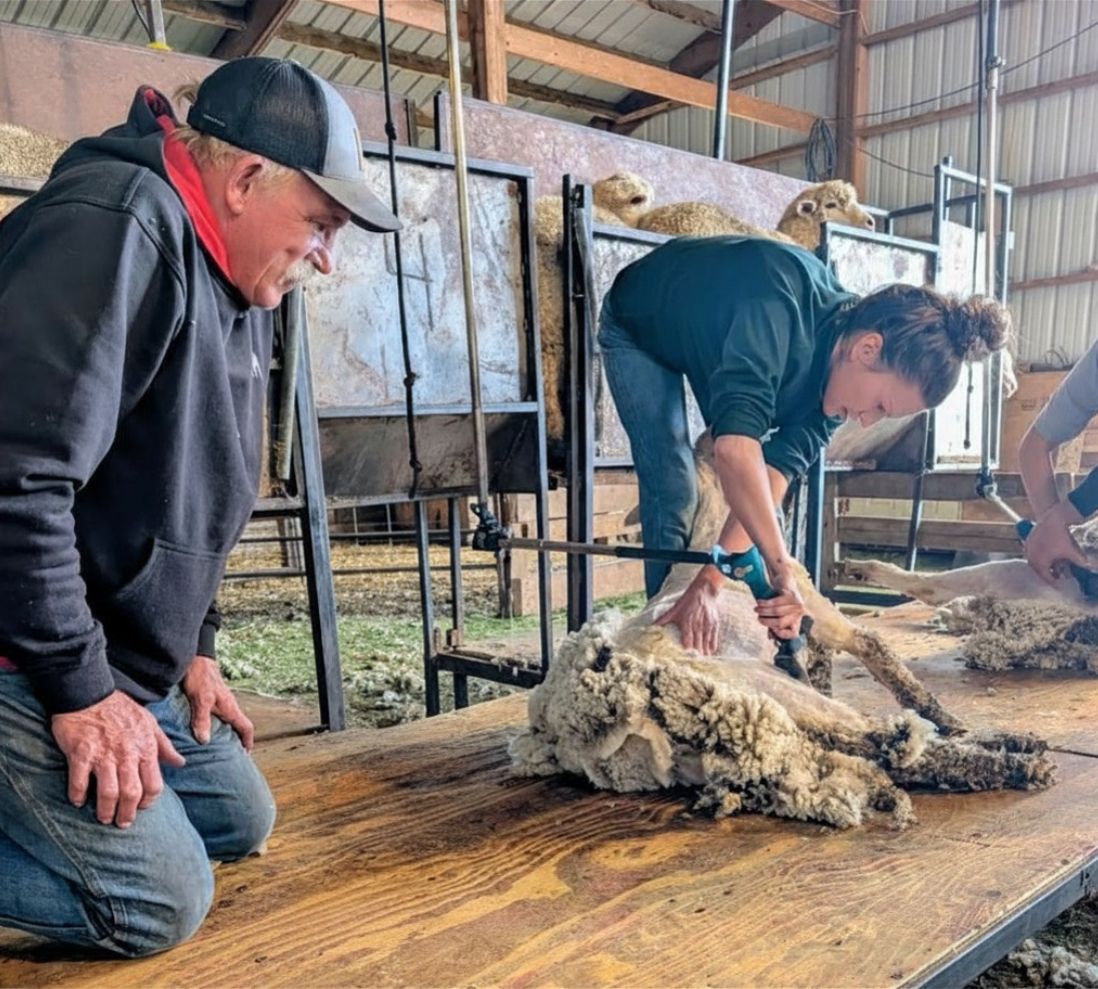
- Building a Workforce: Following the Montana school, two intermediate high school students have started shearing over 50 head per day, positioning them to go fully professional after graduation. Four other area intermediate students are now actively shearing small flocks and their own sheep around the Billings area.
- Filling the Midwestern Void: Two brothers from Missouri attended the school specifically to jumpstart a business back home. Recognizing a regional shortage of both alpaca and sheep shearers, they are using their new skills to build a unique local enterprise.
- Unlocking Wool's Potential: Beyond shearing, the schools have sparked innovative conversations. One South Dakota attendee is currently working with South Dakota State University to explore using raw wool as a sustainable mulch alternative for commercial gardening, an emerging use for the 23.6 million pounds of wool produced annually in the U.S.
"By learning to shear, producers can alleviate the cost and scheduling challenge that is inherent to annual shearing," said Jaelyn Whaley, Extension Field Specialist at South Dakota State University. "With small numbers and tightening margins, learning to shear sheep reduces the annual cost of shearing and supports the future sustainability of the small-scale producers that make up a majority of the industry."
Dig Deeper
- In North Dakota, a Sheep Shearing School is typically held each fall. More Info
- To find sheep shearing classes in South Dakota, visit extension.sdstate.edu/events and search "sheep".

View Related SARE Grant:
- Multi-state safe and humane shearing workshops to address the shortage of US sheep shearers (ONC24-147)