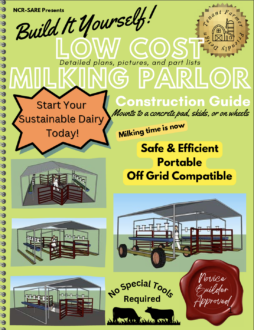
For small-scale dairy producers and herdshare operators, the path to a professional-grade operation can be blocked by the high cost of a milking parlor. These permanent structures can cost thousands and often require advanced skills like welding, a risky investment for "bootstrapping" farmers on rented land.
Travis and Mariah Hurt of North Sky Farm in Harvard, Illinois, lived this reality for years while operating on leased land in Virginia. After relocating their business to Illinois in 2022, they set out to share the lessons they learned while "farming on the move." With support from a $15,000 NCR-SARE Farmer Rancher grant and help from advisors Steven Weaver and Roger Dahlberg, the Hurts have developed a professional, portable, and completely DIY milking parlor.
Designing a DIY Portable Milking Parlor
The team at North Sky Farm followed a careful, step-by-step testing process as they designed and built their portable milking parlour.
- Testing Materials: They researched various "pipe and clamp" structural systems to identify components with the highest weight-bearing capacity that did not require specialized machinery or welding. They focused on finding materials that were weather-resistant, easy to sanitize, and commercially available to the average farmer.
- Prototyping and Trials: The team built and tested several iterations of the parlor stalls. They observed cow behavior during entry and exit to optimize "animal flow," ensuring the final design minimized stress for the livestock and maximized efficiency for the milker.
- Ergonomic Field Testing with Livestock: A key portion of the background work involved testing different platform heights and worker positioning. By measuring the physical strain of various tasks, they refined a design that protects the farmer's back and provides a safe buffer zone to prevent injuries from kicks.
- Documentation: Throughout the construction of the final prototype, the Hurts documented the challenges they faced. This "build-as-you-go" methodology ensured that the final guide addressed common DIY pitfalls and included the exact tool lists and measurements needed for a successful build.
A Path Forward for Farmers
To share the results of their work, they developed a comprehensive manual: "Getting Big Milk Out of Small Dairy: A Milking Parlor Construction Guide For Herdshares, Creameries and Those Bootstrapping on Rented Land." It's a field-tested blueprint designed for farmers who need a parlor that is:
- Sanitary & Durable: The suggested materials are weather-resistant and easy to power-wash, meeting the cleanliness standards required for high-quality milk production.
- 100% Portable: Built using a modular system of high-strength pipes and structural fittings, the entire setup can be disassembled and moved. If a lease ends, the investment stays with the farmer.
- No Welding Required: The design uses specialized clamps and basic hand tools. Farmers don't need to be professional fabricators or hire an expensive contractor to get a good result.
- Comfortable: The elevated design is more ergonomic and creates a physical barrier that protects the farmer from kicks or stepping on, a common risk in improvised stanchion setups.
The team developed this guide because they saw a gap between some homesteading advice they had read and more complex industrial dairy layouts.
"What we learned from this grant was how to build a low-cost milking parlor using basic tools and without advanced building techniques," Travis Hurt reflected. "There are plans, videos, and webinars online showcasing low-cost parlors, but very little information on how to actually build one. This has affected our farm operation because we now have an actual, low-cost DIY milking parlor that can be used and demonstrates that building a parlor on a budget is attainable for farmers, even on rented land. This is a particularly meaningful milestone as we farmed on rented land for a long time and know it is the case for many beginning farmers and ranchers."
Dig Deeper
North Sky Farm has made all its project resources available to the public. Head to their website to find the full guide, financial planning tools to help you budget, and a recorded webinar that walks you through the entire process. View the Resources Here.
Want more information? See the related SARE grant:
This material is based upon work that is supported by the National Institute of Food and Agriculture, U.S. Department of Agriculture through the Sustainable Agriculture Research and Education (SARE) program. Any opinions, findings, conclusions, or recommendations expressed in this publication are those of the author(s) and should not be construed to represent any official USDA or U.S. Government determination or policy.