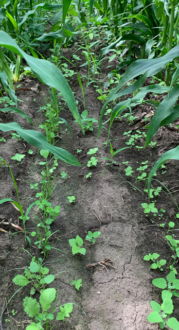
As with many aspects of organic production, fertility management requires careful planning and a long-term outlook. A successful, cost-effective fertility management plan should minimize the purchase of off-farm inputs, while focusing on building soil health and fertility through the use of cover crops, green manures, legume cash crop phases, and crop rotation. If inputs are needed, a number of products approved for organic production are available.
The American Society of Agronomy has created the following resources in collaboration with this research:
- Class: The Basics and Business Opportunities of Transitioning and Organic Grain Crop Production
- Class: What Is Organic Certification and What Needs to be Considered?
- Class: Nutrient Management Strategies for the Organic Transition
- Class: Pest and Weed Management Strategies for the Transitioning Producer
- Class: Systems-level Crop Management for the Organic Transition and Beyond
- Class: The Basics and Business Opportunities of Transitioning and Organic Grain Crop Production
- Podcast: Organic Certifications with Harriet Behar (Audio) (Approved)
- Podcast: Organic Basics and Business Operations with Anders Gurda and Paul Dietmann
- Podcast: The Organic Systems Mindset with Tom Frantzen
- Podcast: Nutrient Cycling in Organic Systems with Dr. Erin Silva
- Video: Organic Agriculture Introduction with Erin Silva
- Fact Sheet: Transitioning to Certified Organic Grain Production
- Fact Sheet: The Organic Transition for Interested Clients: Questions to Consider
- Fact Sheet: Insect and Disease Management in Organic Grain Production
- Fact Sheet: Weed Management in Organic Grain Systems
Want more information? See the related SARE grant:
This material is based upon work that is supported by the National Institute of Food and Agriculture, U.S. Department of Agriculture through the Sustainable Agriculture Research and Education (SARE) program. Any opinions, findings, conclusions, or recommendations expressed in this publication are those of the author(s) and should not be construed to represent any official USDA or U.S. Government determination or policy.