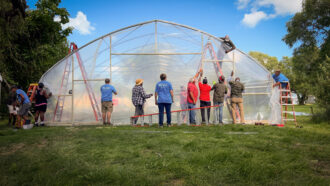
High tunnels give local farmers and flower growers in the Northern Great Plains a powerful way to extend their growing seasons, boost crop yields, and produce higher-quality crops. A video series from South Dakota State University (SDSU) Extension features four local producers sharing practical, step-by-step advice on planning, building, and maintaining high tunnels from start to finish.
"High tunnels serve as an important tool for the expansion of the local food and flower economy across South Dakota and North Dakota as small and diversified farms use high tunnels to grow seasonal fruits, vegetables, and flowers," said Kristine Lang, Assistant Professor and Consumer Horticulture Extension Specialist at South Dakota State University. "In addition to extending the growing season, research has strongly indicated that high tunnels can increase yield, enhance shelf life, and improve the quality of crops grown."
Supported by a SARE grant, the video series offers real-world tips whether you are building your first high tunnel or upgrading an existing structure.
What the Video Series Covers
- Planning & Design: Choosing the right layout, size, and location for your farm.
- Construction Steps: Practical, step-by-step guidance for building a sturdy high tunnel.
- Management & Upkeep: Daily maintenance tips to protect your structure and optimize growing conditions.
- Crop Improvement: How controlled environments extend seasonal availability, increase yields, and improve crop shelf life.
URL: https://youtube.com/playlist?list=PLlldDb7IZYqJQ4UblJ-dIM9gUa98SpxxA&si=k3b7_Ffhumx2Pkvg
Want more information? See the related SARE grant:
This material is based upon work that is supported by the National Institute of Food and Agriculture, U.S. Department of Agriculture through the Sustainable Agriculture Research and Education (SARE) program. Any opinions, findings, conclusions, or recommendations expressed in this publication are those of the author(s) and should not be construed to represent any official USDA or U.S. Government determination or policy.