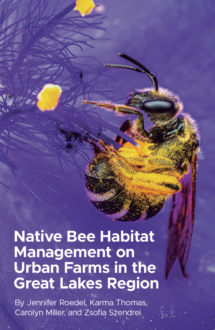
This pocket guide was designed to help urban growers manage pollinator habitat on farms in the Great Lakes Region. Developed with support from an NCR-SARE Research and Education grant, the authors hope that by managing pollinator habitat, farmers can increase the pollination services provided by native wild bees while helping conserve them.
In this guide, the authors focus on native wildflower plantings, a type of habitat composed of herbaceous plants. Bees feed on the pollen and nectar from the flowers and build their nests within the plantings. About 30% of solitary bees will nest in hollow plant stems or holes in wood, like tree trunks or fallen logs. The other 70% of bees nest underground in patches of exposed soil. Native trees and shrubs are also important habitats for bees to nest and feed. Trees and shrubs usually bloom in early spring, so they are some of the first flowers bees can find. However, their larger size and longer lifespan can make them harder to manage in cities.
The plants in this guide were selected because they thrive in urban environments. They also support the bees that are the most valuable pollinators to crops commonly grown on urban farms and gardens.
Get the guide: https://www.canr.msu.edu/resources/native-bee-habitat-management-on-urban-farms-in-the-great-lakes-region
Also available in Spanish: https://www.canr.msu.edu/resources/native-bee-habitat-management-on-urban-farms-in-the-great-lakes-region?language_id=2
Want more information? See the related SARE grant:
- Enhancing sustainable pollination on urban farms using native plant conservation strips and outreach (LNC23-489)
This material is based upon work that is supported by the National Institute of Food and Agriculture, U.S. Department of Agriculture through the Sustainable Agriculture Research and Education (SARE) program. Any opinions, findings, conclusions, or recommendations expressed in this publication are those of the author(s) and should not be construed to represent any official USDA or U.S. Government determination or policy.