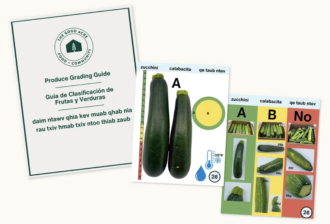
Wholesale buyers expect consistent quality, but clear grading standards are surprisingly hard for local producers to find. Without visual benchmarks, many farmers learn through trial and error, leading to unexpected rejections and lost income on delivery day.
To address this problem, regional food hub The Good Acre in Saint Paul, Minnesota, developed the Produce Grading Guide with funding from a SARE grant. Designed specifically for specialty crop farmers entering wholesale channels, the guide uses detailed photos, crop information, and post-harvest advice to establish clear standards for growers, buyers, and technical advisers alike.
What’s Inside the Guide
- Visual Grading Standards: Clear side-by-side photos showing acceptable vs. unacceptable produce.
- Crop Specifications: Detailed criteria for size, maturity, appearance, and overall quality for specific produce items.
- Defect Identification: Explanations of common cosmetic and quality issues, their root causes, and how to prevent them in the field.
- Multilingual Access: Available in English, Spanish, and Hmong.
How to Use This Resource
- Find Your Crop: Select the specific produce item you are grading using the crop index.
- Compare Your Harvest: Review the photos and specs, including size, appearance, and maturity, to determine if your crop meets wholesale requirements.
- Prevent Future Issues: Use the guide's troubleshooting tips to address field issues and decide the best market outlet for each harvest.
Who It’s For
- Farmers: Grade produce with confidence, reduce rejections at delivery, and build strong wholesale buyer relationships.
- Technical Assistance Providers & Coaches: Use a shared visual baseline when training growers on post-harvest handling.
- Buyers & Food Hubs: Establish clear, consistent receiving standards with local suppliers.
"Selling into wholesale markets requires consistent quality, but clear grading standards are not always easy to find," said Josh Bryceson, Director of Grower Support with The Good Acre. "We created this guide to make wholesale expectations easier to understand through photographs, crop-specific specifications, and practical guidance."
Want more information? See the related SARE grant:
This material is based upon work that is supported by the National Institute of Food and Agriculture, U.S. Department of Agriculture through the Sustainable Agriculture Research and Education (SARE) program. Any opinions, findings, conclusions, or recommendations expressed in this publication are those of the author(s) and should not be construed to represent any official USDA or U.S. Government determination or policy.