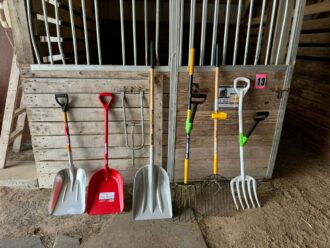
Ergonomic Tool Design for Farmer Well-Being and Productivity
Agricultural labor is physically demanding, often requiring repetitive motions such as digging, lifting, shoveling, and hauling. When tools are poorly matched to the human frame, the resulting musculoskeletal strain can lead to chronic pain in the back, shoulders, wrists, and knees. To address these challenges, researchers at the University of Missouri have been working with farmers to develop resources focused on the intersection of ergonomics and farm labor.
Supported by an NCR-SARE Research and Education grant, the project team produced "A Practical Guide to Shovels and Pitchforks for Researchers, Educators, and Toolmakers." This guide bridges the gap between engineering and the field by translating farmer feedback into actionable design principles.
According to Jianfeng Zhou, project coordinator and professor at the University of Missouri, farmers involved in the project reported improved understanding of how ergonomics affects comfort, injury risk, and efficiency.
Key Insights for Tool Innovation
The guide for toolmakers emphasizes that minor adjustments to tool geometry can yield significant improvements in operator safety and efficiency. Highlights include:
- Evidence-Based Design: Integrating ergonomic data with real-world feedback from producers to ensure tools meet the rigors of daily use.
- User-Centric Modifications: Demonstrating how small changes, such as handle length or grip angle, reduce physical exertion.
- Education and Extension: Providing scientists and engineers with the criteria necessary to design tools that accommodate diverse body types.
By prioritizing "the right tool for the right job," this SARE-funded initiative has been addressing the gap in ergonomic design for farming tools and small-sized farming equipment.
"One significant change observed in farmers and ranchers at the MU Equine Teaching Facility is their approach to using shovels and pitchforks," explained Zhou. Through our project, participants now get closer to the load, such as straw to be thrown, and understand that these tools operate as third-class lever devices. They have learned that the hand on the shaft acts as the effort hand, while the one on the grip serves as the fulcrum, providing support. This knowledge helps them use both hands properly and apply appropriate force more efficiently. This change in practice has led to improved control and reduced physical strain during their tasks."
Resources for Farmers
Beyond technical specifications for manufacturers, the team developed a suite of educational videos designed for direct outreach to farmers. These videos empower producers to:
- Identify the most appropriate tool for specific tasks.
- Implement proper body mechanics to prevent long-term injury.
- Modify existing equipment to better fit their individual physical needs.
Want more information? See the related SARE grant:
This material is based upon work that is supported by the National Institute of Food and Agriculture, U.S. Department of Agriculture through the Sustainable Agriculture Research and Education (SARE) program. Any opinions, findings, conclusions, or recommendations expressed in this publication are those of the author(s) and should not be construed to represent any official USDA or U.S. Government determination or policy.