Showing 81-100 of 112 results
Increasing Varietal Suitability and Availability of Cowpea and Forage Radish Cover Crop Seed for Northern Climates
With support from a $199,776 Research and Education grant, the Northern Plains Sustainable Agriculture Society Farm Breeding Club and university partners at NDSU, SDSU, UW-Madison, and the University of Puerto Rico, have been evaluating cowpeas and daikon radish from around the world for use and seed production in the Dakotas. On-farm evaluation, selection, and evolutionary […]
Squash in Sustainable Food Production
Sue Isbell is a 4-H Youth Development Agent with NDSU Extension Service in Sioux County, ND. In 2013, she received an NCR-SARE Youth Educator grant to work with youth from three Tribal communities across North Dakota on activities about sustainable agriculture, local foods, gardening methods, marketing, and concepts and practices of breeding and seed saving. […]
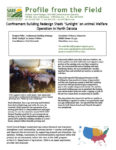
Confinement Building Redesign Sheds ‘Sunlight’ on Animal Welfare
Paul Sobocinski has a 240 acre crop and livestock farm that includes hogs and cattle. In 2001, he received a SARE grant for the conversion of an existing pole barn to a deep bedded sow and piglet nursery. In 2012 he received a second NCR-SARE Farmer Rancher grant for $7,450 to renovate an existing 24 […]

Making Goats Milk Soap Business Sustainable by Implementing Standard Manufacturing and Testing Protocols
Penny and Jay Adler own and operate the 444Farm in Hazel, South Dakota. They have 40 acres (half in wetlands) where they have implemented sustainable grazing practices by replacing water systems, re-sowing pastures, installing high tensile fences, and creating paddocks for rotational grazing. They raise dairy goats and make goat’s milk soap and lotion. They […]
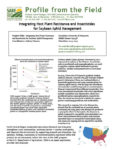
Integrating Host Plant Resistance and Insecticides for Soybean Aphid Management
Soybean aphids (Aphis glycines Matsumura), are a major pest of soybean in the Midwest. Insecticides, such as pyrethroids and organophosphates, are used to suppress soybean aphid outbreaks to prevent yield loss. Another management tactic is host-plant resistance. In 2013, University of Minnesota graduate student Anthony Hanson, received a $9,938 Graduate Student grant to determine if […]
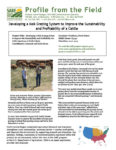
Developing a Mob Grazing System to Improve the Sustainability and Profitability of a Cattle Operation in North Dakota
Jeremiah and Krista Reiser run an all grass operation on 2,700 acres of native prairie in central North Dakota. They run a herd of leased and owned spring calving cows and also custom graze the excess grass that is not planned for their own herd. In 2010, they received a $5,991 NCR-SARE Farmer Rancher Grant […]
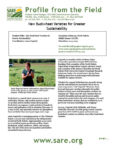
New Buckwheat Varieties for Greater Sustainability
Buckwheat is a speedy short-season cover crop. It establishes, blooms, and reaches maturity in just 70-90 days and its residue breaks down quickly. Buckwheat can suppress weeds and attract beneficial insects and pollinators with its abundant blossoms. It is easy to kill, and reportedly extracts soil phosphorus from soil better than most grain-type cover crops. […]
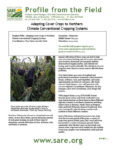
Adapting Cover Crops to Northern Climate Conventional Cropping Systems
Northeast Minnesota is home to a large beef cow-calf sector, several dairy farms, and an increasing amount of cash grain farming. In each of these types of operations, annual cultivation of corn, soybeans, oats, and barley is common. Annual cultivation of these crops can lead to high rates of nutrient leaching and soil erosion, decreased […]
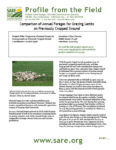
Comparison of Annual Forages for Grazing Lambs on Previously Cropped Ground
Michael Seipel, his wife, and three children raise livestock on pasture in northeast Missouri. Michael also teaches agricultural business and sustainable agriculture courses at Truman State University. In 2013, Michael Seipel received an NCR-SARE Farmer Rancher grant to look at the economics of grazing lambs on spring, summer, and winter annual forage crops as compared […]
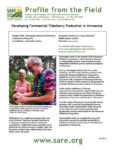
Developing Commercial Elderberry Production in Minnesota
Elderberries are a rapidly growing specialty crop in the Midwest. They have multiple functions in a cropping system because they are perennial, ornamental, a wildlife food source, and they can be planted in low-lying wet areas as a buffer. They can be used to produce value-added products like jams, jellies, wines, and juices. Christopher Patton […]
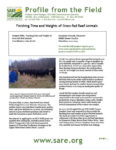
Finishing Time and Weights of Grass-fed Beef Animals
For more than 20 years, Jane Jewett has owned WillowSedge Farm near Palisade, Minneosta. She and her family raise and direct-market pork, poultry, lamb, and grass-fed beef on 113 acres. An increasing interest in grass-fed beef operations led Jewett to make the transition to grass-fed beef in 2008. Her interest in applying for an NCR-SARE […]
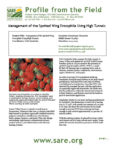
Management of the Spotted Wing Drosophila Using High Tunnels
Scenic Valley Farms is a family owned farm in Rosemount, Minnesota that uses 15 climate controlled high tunnels to produce organically certified tomatoes, peppers, cucumbers, blackberries, strawberries, herbs, ginger, turmeric, and garlic. They also design and manage high tunnels, computerized climate control systems, and subterranean solar thermal heating systems. Erik Gundacker helps manage the high […]
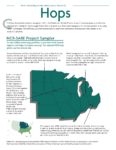
Hops
Craft beer brewing has enjoyed a resurgence in the United States over the last 30 years. As small breweries spring up, so does the opportunity for nearby farmers to supply them with locally grown hops. From weed management, to pest management, to exploring marketing strategies, NCR-SARE has supported work by farmers, researchers, and brewers that has promoted sustainable hop production practices.
Managing Drought Risk On the Ranch
Producers throughout the nation continue to grow increasingly concerned about water scarcity. Farmers, ranchers, and agricultural educators are exploring new approaches to the challenges associated with water shortage and drought. The National Drought Mitigation Center, (NDMC) based in Lincoln, NE, has a mission of “helping people and institutions develop and implement measures to reduce societal […]
Profitable Rabbit Production
Rabbit meat is high in protein and low in fat, cholesterol, and sodium when compared to most of the meats eaten in the U.S. Rabbit meat has great potential to feed people in developing countries and could be promoted in the U.S. as a healthful, natural meat and a small farm asset (Fanatico, Anne. “Rabbit […]

Sustainable Agriculture Learning Modules for High School Agriculture
Established with the aid of a NCR-SARE Professional Development grant, these Sustainable Agriculture Learning Modules from the University of Nebraska-Lincoln were created to offer insight into what sustainability within agriculture actually looks like.
Toward a Sustainable Agriculture: A Curriculum for High School Classes
This free high-school curriculum addresses the social, environmental and economic impacts of agriculture. The curriculum provides a critical analysis of agricultural and food systems, and helps students understand new concepts through hands-on examples. The curriculum includes six modules, designed to be incorporated into existing classes.
Good Agricultural Practices for Agricultural Professionals
Due to recent outbreaks of foodborne illnesses, consumers are concerned about food safety, and an increasing number of wholesale and institutional buyers are requiring growers to have GAPs certification, which focuses on reducing microbial risks to fresh fruits and vegetables. Cary Rivard and Jeffrey Callaway developed a program to train agricultural professionals, including Extension agents, […]
Iowa Farmer Mechanizes Planting and Maintenance Tasks in Vegetables with Companion Plants
The Genuine Faux Farm, operated by Rob and Tammy Faux since 2004, is a small family operation that grows a wide variety of vegetables that are sold and distributed to about 120 community supported agriculture (CSA) customers. Produce also is sold via farmers’ markets and direct sales to a daycare, retirement center, and grocery store. […]
Michigan State Graduate Student Explores the Benefits of Adding Cover Crops to Vegetable Production
Cover crops can help slow erosion, improve soil, smother weeds, enhance nutrient and moisture availability, help control many pests, and bring a host of other benefits to farms across the country. Cereal-legume cover crop mixtures are of particular interest to growers because they can effectively suppress weeds, control erosion, and scavenge leachable nitrate while also […]