Showing 21-40 of 43 results
Profitable Rabbit Production
Rabbit meat is high in protein and low in fat, cholesterol, and sodium when compared to most of the meats eaten in the U.S. Rabbit meat has great potential to feed people in developing countries and could be promoted in the U.S. as a healthful, natural meat and a small farm asset (Fanatico, Anne. “Rabbit […]
Iowa Farmer Mechanizes Planting and Maintenance Tasks in Vegetables with Companion Plants
The Genuine Faux Farm, operated by Rob and Tammy Faux since 2004, is a small family operation that grows a wide variety of vegetables that are sold and distributed to about 120 community supported agriculture (CSA) customers. Produce also is sold via farmers’ markets and direct sales to a daycare, retirement center, and grocery store. […]
Michigan State Graduate Student Explores the Benefits of Adding Cover Crops to Vegetable Production
Cover crops can help slow erosion, improve soil, smother weeds, enhance nutrient and moisture availability, help control many pests, and bring a host of other benefits to farms across the country. Cereal-legume cover crop mixtures are of particular interest to growers because they can effectively suppress weeds, control erosion, and scavenge leachable nitrate while also […]
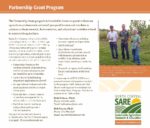
Partnership Grant Fact Sheet
The Partnership Grant program is intended to foster cooperation between agriculture professionals and small groups of farmers and ranchers to catalyze on-farm research, demonstration, and education activities related to sustainable agriculture.
Rancher Internship Program Invests in the Future of Kansas Agriculture
Ranch ownership transitions can be complex, involving issues such as generational needs, tax issues, social attitudes, and recreational landowner competition. In an effort to help simplify the process, Calvin Adams of Beloit, KS, Cade Rensink of Ada, KS, and Ted Alexander of Medicine Lodge, KS, and the Kansas Ranch and Range Management Internship Program are […]
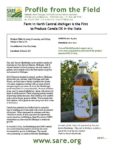
Farm in North Central Michigan is the First to Produce Canola Oil in the State
Dan and Bonnie Blackledge have started a canola oil business on their farm in Marion, Michigan. B & B Farms Canola Oil’s first pressing was only about 50 gallons, but it stands out as the first canola oil grown and pressed in Michigan. B & B Farms is located in central, northern Michigan about mid-way […]
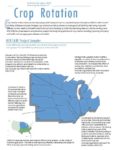
Crop Rotation
Crop rotation is the ancient practice of growing a wide variety of crops in a sequential system throughout a field in order to avoid a buildup of disease and pests. Strategic crop rotations can help producers promote good soil health by alternating crops with different nutrient needs and benefit overall soil structure by breaking up subsoil by alternating deep and shallow rooting plants. NCR-SARE supports research and education projects that study the applications of crop rotation-including improving soil quality and health, and managing pests, diseases, and weeds.
Handbook for Agroforestry Planning and Design
The steps provided in the Handbook for Agroforestry Planning and Design will allow you to identify what agroforestry products can grow on your land, which of these products you can sell profitably, and how to develop basic business and marketing strategies.
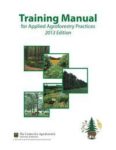
Training Manual for Applied Agroforestry Practices
The Training Manual for Applied Agroforestry Practices helps to explain agroforestry practices and their applications. It is designed for natural resources professionals and landowners, and includes worksheets and exercises for use as an educational tool. Additionally, the manual is designed to assist in the decision process so that, when established or managed, the agroforestry practice is most effective at achieving the desired objectives.
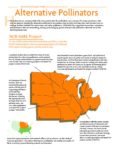
Alternative Pollinators
Honeybee losses compounded with rising rental rates for pollination are a concern for many producers. Not only are growers looking for alternative pollinators to improve crop security, but they also want to learn how to manage on-farm habitats for native bees and other pollinators. NCR-SARE has supported researchers, educators, and producers who are researching, rearing, and managing species that provide pollination alternatives to the declining honey bee.
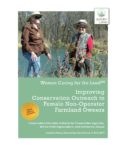
Women Caring for the Land: Improving Conservation Outreach to Female Non-Operator Farmland Owners Curriculum Manual
With the help of an NCR-SARE Research and Education Grant and funding from other sources, WFAN developed an award winning curriculum called Women Caring for the LandSM (WCL), which is designed to serve female non-operator landowners who are interested in learning more about conservation and other land management topics. The materials are also appropriate to teach youth about sustainable agriculture through hands-on conservation activity lesson plans.
GAP for Urban Food Producers
This PowerPoint presentation, "Good Agricultural Practices (GAP) and Good Handling Practices (GHP) for Urban Food Producers" was created by SARE Ohio State Coordinator, Mike Hogan.
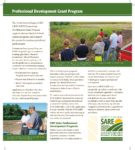
Professional Development Grant Fact Sheet
The North Central Region SARE (NCR-SARE) Professional Development Grant Program supports state professional development programs and competitive grants for training agricultural professionals.
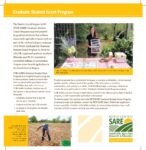
Graduate Student Grant Fact Sheet
The North Central Region SARE (NCR-SARE) Graduate Student Grant Program supports projects by graduate students that address sustainable agriculture issues and are part of the student’s degree program. NCR-SARE instituted the Graduate Student Grant Program in 2002 for officially registered graduate students (Masters and Ph.D.) enrolled at accredited colleges or universities. Projects must benefit agriculture in the North Central Region.
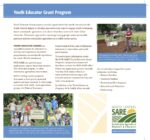
Youth Educator Grant Fact Sheet
The North Central Region SARE (NCR-SARE) recognizes that youth programs are a way to introduce new and exciting farming and ranching options to youth, parents, and community members. Youth Educator grants support projects by youth educators that encourage youth to try sustainable practices and explore sustainable agriculture as a viable career option.
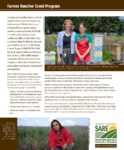
Farmer Rancher Grant Fact Sheet
NCR-SARE’s Farmer Rancher Grant Program is a competitive grants program for farmers and ranchers who want to explore sustainable solutions to problems through on-farm research, demonstration, and education projects.
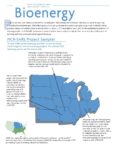
Bioenergy
Politicians, farmers, and investors across the U.S. are enthusiastic about the potential economic benefits and use of energy crops to revitalize the rural landscape. NCR-SARE hopes to more clearly articulate the need to use a systems approach to identify critical questions, develop innovative solutions, and solve both on-site and off-site problems that might limit the sustainable development of bioenergy production. NCR-SARE has invested in research and education projects to help achieve the sustainability of all aspects of bioenergy and those communities that support bioenergy.
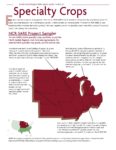
Specialty Crops
From Aronia berries to elderberries, wine grapes to bitter melon, NCR-SARE-funded research is helping specialty crop farmers across the region use sustainable practices to battle pests, tap into lucrative markets, and increase yields. 16 percent of NCR-SARE’s 20-year research portfolio has been devoted to growing fruits, nuts, vegetables, and other specialty crops in ways that boost profits, protect the land, and strengthen communities.
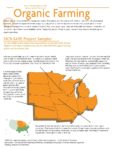
Organic Agriculture
Organic agriculture is a whole-farm management system that replaces synthetic inputs with methods that mimic natural ecological processes. Demand for organic food is far outpacing supply, as U.S. sales in this dynamic sector have nearly quadrupled in the last decade. NCR-SARE has invested in more than 100 projects to help achieve the sustainability and well-being of all aspects of organic agriculture and those communities that support organic producers.

NCR-SARE Display
A display describing the NCR-SARE program for use at meetings, conferences, field days, etc.