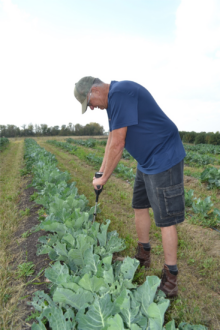
Twenty-six years in the Whitewater Valley in Minnesota have taught Sandra and Lonny Dietz a lot about what it takes to grow healthy produce. On their 80-acre farm, traditional tillage was causing compaction and a constant headache from Canada thistle and foxtail.
Seeking a more sustainable path, Sandy and Lonny Dietz received a $14,867 NCR-SARE Farmer Rancher grant to identify which no-till methods could best support their diverse, organic vegetable operation.
The Study: Three Paths to Minimal Disturbance
Their project compared three distinct no-till treatments against a traditional tilled control plot:
- Deep Compost Mulch: Planting directly into six inches of compost.
- Cut-and-Carry Mulch: Planting into mowed residue topped with six inches of hay or straw.
- Living Mulch: Seeding Dutch white clover into residues to create a permanent green cover.
Key Findings: Labor, Cost, and Soil Dynamics
Through two full growing seasons (2023 and 2025), the Dietzes observed that while no-till methods offered benefits, they also presented unique challenges for small-scale organic growers:
- Hay Mulch Proved Most Resilient: The "cut-and-carry" hay mulch treatment resulted in the best overall plant health. These beds maintained steady moisture levels and higher nitrogen availability, likely due to the use of high-quality alfalfa hay, resulting in deep-green plants and robust flowering.
- Compost Imbalances: While the deep compost mulch initially suppressed weeds, it was the most expensive option and eventually led to nutrient imbalances. Dietz noted that without a cover over the compost, nitrogen tended to off-gas, causing some crops, such as peppers, to yellow.
- Living Mulch Challenges: The living mulch approach struggled in the farm's heavy clay soils. Poor clover germination allowed weeds to take over, which then competed with the vegetable crops for vital nutrients.
- The Reality of Labor: One of the project's most surprising findings was that no-till did not significantly reduce total labor; rather, it shifted the timing of labor. Instead of season-long cultivation, labor was front-loaded into the heavy application of mulches and compost at the start of the year.
Recommendations for a Hybrid Approach
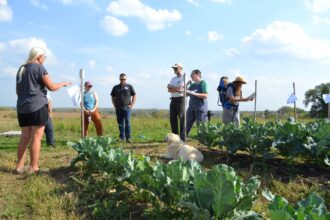
The couple concluded that for farms dealing with poor soil health or heavy compaction, simply stopping tillage is not enough.
Based on these results, the Dietzes recommend a hybrid approach for vegetable growers transitioning to no-till:
- Strategic Fertility: Apply a smaller amount of compost (approximately one inch) and lightly work it into the top layer of soil to address nutrient deficiencies.
- Protective Mulching: Cover the soil with approximately six inches of hay or straw mulch to preserve moisture and suppress weeds.
- Biological Boosting: Incorporate routine additions of compost teas or extracts to stimulate soil biology and help "jumpstart" the transition from tilled to no-till systems.
"This study has generated many questions and ideas and has us interested in potentially using a hybrid of these treatments in the future," said Sandy Dietz. "We continue to pursue ways to better manage the soil and expand on the knowledge that we have acquired in this work."
Dig Deeper
Check out this NCR-SARE Farming Matters episode where Sandy Dietz shared the story of their SARE project.