Showing 61-70 of 70 results
Handbook for Agroforestry Planning and Design
The steps provided in the Handbook for Agroforestry Planning and Design will allow you to identify what agroforestry products can grow on your land, which of these products you can sell profitably, and how to develop basic business and marketing strategies.
Training Manual for Applied Agroforestry Practices
The Training Manual for Applied Agroforestry Practices helps to explain agroforestry practices and their applications. It is designed for natural resources professionals and landowners, and includes worksheets and exercises for use as an educational tool. Additionally, the manual is designed to assist in the decision process so that, when established or managed, the agroforestry practice is most effective at achieving the desired objectives.
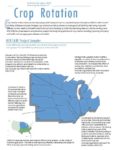
Crop Rotation
Crop rotation is the ancient practice of growing a wide variety of crops in a sequential system throughout a field in order to avoid a buildup of disease and pests. Strategic crop rotations can help producers promote good soil health by alternating crops with different nutrient needs and benefit overall soil structure by breaking up subsoil by alternating deep and shallow rooting plants. NCR-SARE supports research and education projects that study the applications of crop rotation-including improving soil quality and health, and managing pests, diseases, and weeds.
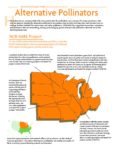
Alternative Pollinators
Honeybee losses compounded with rising rental rates for pollination are a concern for many producers. Not only are growers looking for alternative pollinators to improve crop security, but they also want to learn how to manage on-farm habitats for native bees and other pollinators. NCR-SARE has supported researchers, educators, and producers who are researching, rearing, and managing species that provide pollination alternatives to the declining honey bee.
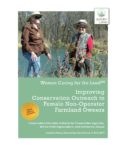
Women Caring for the Land: Improving Conservation Outreach to Female Non-Operator Farmland Owners Curriculum Manual
With the help of an NCR-SARE Research and Education Grant and funding from other sources, WFAN developed an award winning curriculum called Women Caring for the LandSM (WCL), which is designed to serve female non-operator landowners who are interested in learning more about conservation and other land management topics. The materials are also appropriate to teach youth about sustainable agriculture through hands-on conservation activity lesson plans.
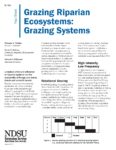
Maintenance of Natural Sustainable Riparian Communities Fact Sheets Series
A graduate student from North Dakota State University created these five extension fact sheets after monitoring and reporting on the riparian ecosystem associated with the Middle Sheyenne River, a perennial stream in eastern North Dakota.
Woodchip Bioreactors for Nitrate in Agricultural Drainage
Woodchip bioreactors, installed at the edge of agricultural fields, can remove 15 to 60 percent of the nitrate in tile-drained water annually. This innovative approach for protecting the water quality in Midwest streams and rivers is described in a new fact sheet available from Iowa State University.
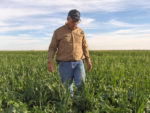
Dakota Farmer's Success Catches On
Dan Forgey has always had an abiding respect for the land that he has farmed for more than 40 years, which is why, as manager of the 8,500-acre Cronin Farms in Gettysburg, S.D., he strives to build soil health—and yields—sustainably. First, he shifted the farm to 100 percent no-till in 1993, around the time that […]
Integrated Weed Management - One Year's Seeding
Weed biology and ecology can help every farmer become a better weed manager. This guide is the result of a series of winter meetings attended by Michigan farmers, MSU Extension agents and research scientists. It brings together field-tested experience from successful growers and Extension agents and insights distilled from more than 50 years of weed science research.
Considering Sustainable Agriculture on Your Rented Land
Using sustainable agriculture practices on your rented land can help protect soil and water quality, increase income over the long term, and satisfy personal values for the landowner and/or the tenant.