Showing 261-280 of 304 results

Dale Mutch: NCR-SARE Hero
Read more about Dale Mutch.
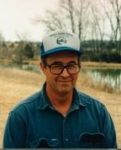
Ron Macher: NCR-SARE Hero
Read more about Ron Macher.
Good Agricultural Practices for Agricultural Professionals
Due to recent outbreaks of foodborne illnesses, consumers are concerned about food safety, and an increasing number of wholesale and institutional buyers are requiring growers to have GAPs certification, which focuses on reducing microbial risks to fresh fruits and vegetables. Cary Rivard and Jeffrey Callaway developed a program to train agricultural professionals, including Extension agents, […]
Iowa Farmer Mechanizes Planting and Maintenance Tasks in Vegetables with Companion Plants
The Genuine Faux Farm, operated by Rob and Tammy Faux since 2004, is a small family operation that grows a wide variety of vegetables that are sold and distributed to about 120 community supported agriculture (CSA) customers. Produce also is sold via farmers’ markets and direct sales to a daycare, retirement center, and grocery store. […]
Michigan State Graduate Student Explores the Benefits of Adding Cover Crops to Vegetable Production
Cover crops can help slow erosion, improve soil, smother weeds, enhance nutrient and moisture availability, help control many pests, and bring a host of other benefits to farms across the country. Cereal-legume cover crop mixtures are of particular interest to growers because they can effectively suppress weeds, control erosion, and scavenge leachable nitrate while also […]
Nebraska Nonprofit Teaches Youth and Community About Sustainability
A nonprofit organization that has made a difference for beginning, immigrant, and refugee farmers in Lincoln, Nebraska is now reaching out to youth. Community CROPS (Combining Resources, Opportunities, and People for Sustainability) has a simple, but lofty mission - help people work together to grow healthy food and live sustainably. What started as a single […]
Producers and Researchers Collaborate to Improve Soil Health in North Dakota
Soil—and whole farms—have been renewed through soil-improving practices like cover crops and no till. In the semiarid plains of western North Dakota, a team of producers and researchers are working to boost soil health for improved yield stability, farm income, and natural resource health of farms. The Southwest North Dakota Soil Health Project is a […]
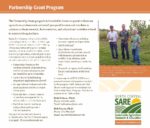
Partnership Grant Fact Sheet
The Partnership Grant program is intended to foster cooperation between agriculture professionals and small groups of farmers and ranchers to catalyze on-farm research, demonstration, and education activities related to sustainable agriculture.
In Memory of Bill Wilcke
Bill Wilcke, image courtesy of the University of Minnesota On November 18, 2013, our dear SARE colleague and friend, Dr. William (Bill) Wilcke, passed away. Bill was born and raised on a small, diversified crop and livestock farm in northwest Iowa. As with many farming families in […]
Rancher Internship Program Invests in the Future of Kansas Agriculture
Ranch ownership transitions can be complex, involving issues such as generational needs, tax issues, social attitudes, and recreational landowner competition. In an effort to help simplify the process, Calvin Adams of Beloit, KS, Cade Rensink of Ada, KS, and Ted Alexander of Medicine Lodge, KS, and the Kansas Ranch and Range Management Internship Program are […]
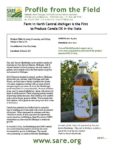
Farm in North Central Michigan is the First to Produce Canola Oil in the State
Dan and Bonnie Blackledge have started a canola oil business on their farm in Marion, Michigan. B & B Farms Canola Oil’s first pressing was only about 50 gallons, but it stands out as the first canola oil grown and pressed in Michigan. B & B Farms is located in central, northern Michigan about mid-way […]
Julie Engel and her Sustainable System for Raising Rabbits on Pasture
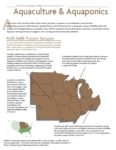
Aquaculture and Aquaponics
Aquaculture is the cultivation of fish, aquatic animals, and plants. Aquaponics is a bio-integrated system that links recirculating aquaculture with hydroponic vegetable, flower, and/or herb production. In aquaponics, nutrient-rich effluent from fish tanks is used to fertigate hydroponic production beds. SARE has supported advances by producers, researchers, and educators that are helping to advance aquaculture and aquaponics into working models of sustainable production.
Alternative Pollinators
Honeybee losses compounded with rising rental rates for pollination are a concern for many producers. Not only are growers looking for alternative pollinators to improve crop security, but they also want to learn how to manage on-farm habitats for native bees and other pollinators. NCR-SARE has supported researchers, educators, and producers who are researching, rearing, and managing species that provide pollination alternatives to the declining honey bee.
Crop Rotation
Crop rotation is the ancient practice of growing a wide variety of crops in a sequential system throughout a field in order to avoid a buildup of disease and pests. Strategic crop rotations can help producers promote good soil health by alternating crops with different nutrient needs and benefit overall soil structure by breaking up subsoil by alternating deep and shallow rooting plants. NCR-SARE supports research and education projects that study the applications of crop rotation-including improving soil quality and health, and managing pests, diseases, and weeds.
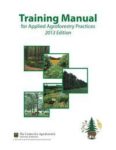
Training Manual for Applied Agroforestry Practices
The Training Manual for Applied Agroforestry Practices helps to explain agroforestry practices and their applications. It is designed for natural resources professionals and landowners, and includes worksheets and exercises for use as an educational tool. Additionally, the manual is designed to assist in the decision process so that, when established or managed, the agroforestry practice is most effective at achieving the desired objectives.

Handbook for Agroforestry Planning and Design
The steps provided in the Handbook for Agroforestry Planning and Design will allow you to identify what agroforestry products can grow on your land, which of these products you can sell profitably, and how to develop basic business and marketing strategies.
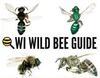
Spring Wild Bees of Wisconsin Online Identification Guide
The Spring Wild Bees of Wisconsin online guide is designed to help users identify wild bees commonly found in Wisconsin in the spring and early summer by their color, shape, size, and habitat. Users can learn to distinguish among different types of bees and learn about the important roles they play in nature and agriculture.
NCR-SARE Establishes “NCR-SARE Hero Recognition,” Honors Bill Wilcke
Bill Wilcke, photo courtesy of the University of Minnesota NCR-SARE is pleased to announce that William F. Wilcke is the first person to receive the “NCR-SARE Hero Recognition.” Coordinated by the NCR-SARE Alumni Organization, this recognition recognizes the leadership, vision, contributions, and impact that these heroes have made […]

Bill Wilcke: NCR-SARE Hero
Read more about Bill Wilcke.