Showing 1-20 of 24 results
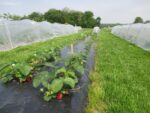
Tunnel Systems Offer Regional Strawberry Growers a Path to Resilience
Researchers at Purdue University have been working to determine if tunnel-based systems and plasticulture could stabilize yields and improve profitability for local strawberry growers.

Strawberry Chat Podcast
Strawberry Chat is a virtual discussion about strawberry production at small and diversified farms in Indiana and neighboring states. The hosts, Wenjing Guan and Miranda Purcell of Purdue University, invite guests to discuss activities that happen at the time of the year and cover different production systems. URL: https://anchor.fm/strawberrychat
Strawberries: Season Extension
This University of Minnesota publication shares the experiences of two farmer who tried growing day neutral strawberries in high tunnels using a table top system. It shares their experiences in the areas of production, yield and marketing, with a budget analysis. The farmers are Todd and Tracy Linbo, of Double T Acres, and Aaron Wills, […]
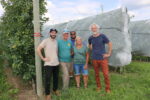
Netting for Better Apples: A Sustainable Alternative to Thinning and Pest Control
In Michigan, researchers and apple growers have been testing the use of exclusion netting as a non-chemical thinning method.
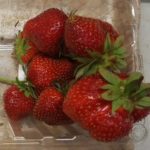
Tenth Street Orchard Tests Sustainable Strawberry Production Methods in Kansas
With SARE support, Tenth Street Orchard compared soil health and profitability of annual plasticulture and a combination plasticulture/matted-row system for strawberry production in central Kansas.

Growing Peaches in Minnesota: A Cold-Climate Success Story
With support from a SARE grant, Dan Sheild developed a peach-growing system tailored to Minnesota’s harsh winters.
The Fruit and Nut Compass
The Fruit and Nut Compass is a farm business planning tool to help both new and experienced producers project the financial costs and returns from an enterprise focused on perennial crops.
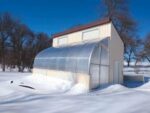
High-Efficiency, Year-Round Tropical Greenhouse in South Dakota
In Aurora, South Dakota, Shannon Mutschelknaus received SARE support to compare the various features of multiple passive solar greenhouse designs.
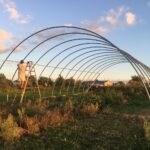
Figs as a Niche Crop in Northern Ohio
Tim and Beth Malinich received a SARE grant to experiment with overwintering methods for raising figs on their Ohio farm.
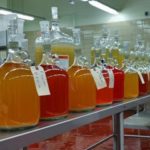
Comparing Apples to Apples
In Wisconsin, producers and researchers are exploring hard cider apple varieties.
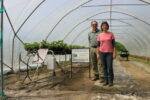
Improving Strawberry Ergonomics
At Tanglewood Farm, Richard Barnes and Kelly St John have been experimenting with elevated cropping systems to reduce labor fatigue and improve fruit quality.
The American Kestrel: an IPM Friend for Michigan’s Fruit Growers
Cherry producers across the region are all too familiar with starlings, finches, voles, pocket gophers, and other animals that can wreak havoc on a cherry orchard by feeding on ripening fruit and developing roots or shoots. These little pests can be a big problem for Michigan’s cherry growers, who grow 75 percent of all tart cherries and 20 percent of sweet cherries in […]
Apples for Artisanal Cider: Understanding the Characteristics of Single Varietals
Hard cider is a beverage that is rooted in history, dating back to 55 BC when the Romans discovered it in England. Today, it is emerging as a potentially fruitful business opportunity for modern and future producers. Two of the producers who have contributed to that growth are Wisconsinites Marie and Matt Raboin, who made their […]
Selecting a New Array of Crisp Apples for Increased Consumer Demand and Grower Profit
Apples are the most consumed fruit in the U.S. The United States has 7,500 apple producers who grow, on average, 240 million bushels of apples each year. These producers grow the apples on an approximated 322 thousand acres of land (U.S. Apple Association, 2018). Two of those apple producers are Steven and Connie Doud, who own […]
The Fruit and Nut Compass: Developing a Tool and Guiding Principles for Diversified Farms
As interest in diversified perennial production grows, farmers across the region have been searching for sustainable ways to battle pests, tap into lucrative markets, and increase yields as they work to develop biodiverse agricultural ecosystems. Building on the concept of their Veggie Compass project, and the desire to develop whole farm profit management tools and […]
Sustainable Pest Management Approaches for Raspberry Growers
Spotted wing Drosophila (SWD) (Drosophila suzukii) is a gnat-sized fly that will damage ripe or ripening fruits such as raspberries, strawberries, and blueberries. Heather Leach, a Michigan State University graduate student in Rufus Isaacs’ Berry Crops Entomology lab says that in 2014, SWD caused estimated economic losses of $159 million in U.S. raspberry production (Burrack […]
Developing a Method to Capture and Authenticate Single Varietal Honey on Diverse Landscapes
Between April and May the apple orchards and fields at Curtis Orchard and Pumpkin Patch in Champaign, Illinois boast plenty of blossoms for hungry pollinators. Curtis is part of an Illinois centennial farm, founded in 1873, offering apples, pumpkins, honey, and a variety of agritourism adventures. All fun aside, they’re quite serious about sustaining their […]
Apples for Artisanal Cider: Understanding the Characteristics of Single Varietals
In 55 B.C., when the Romans reached England, they noticed villagers drinking an alcoholic apple drink. Many years and pints later, in the United States alone, hard cider production increased from 0.8 million gallons in 2007 to 5.2 million gallons in 2012 (Alcohol and Tobacco Tax and Trade Bureau, 2013). A couple of the producers who […]
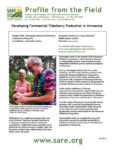
Developing Commercial Elderberry Production in Minnesota
Elderberries are a rapidly growing specialty crop in the Midwest. They have multiple functions in a cropping system because they are perennial, ornamental, a wildlife food source, and they can be planted in low-lying wet areas as a buffer. They can be used to produce value-added products like jams, jellies, wines, and juices. Christopher Patton […]
Toward a Sustainable Agriculture: A Curriculum for High School Classes
This free high-school curriculum addresses the social, environmental and economic impacts of agriculture. The curriculum provides a critical analysis of agricultural and food systems, and helps students understand new concepts through hands-on examples. The curriculum includes six modules, designed to be incorporated into existing classes.